
Infrastructure management

One City, One Map
digital infrastructure management

Is knowledge about your city assets scattered across binders, spreadsheets, and employee notes? URBAN ends that chaos. The Infrastructure Management module is a central nervous system that creates a living digital map of all city assets, from luminaires and benches to waste bins and cable routes.

Modern streetlight in the city at dusk

One System, Full City View
What can you gain?

Transform asset management from reactive firefighting into proactive strategic planning.

Create a digital twin of your infrastructure

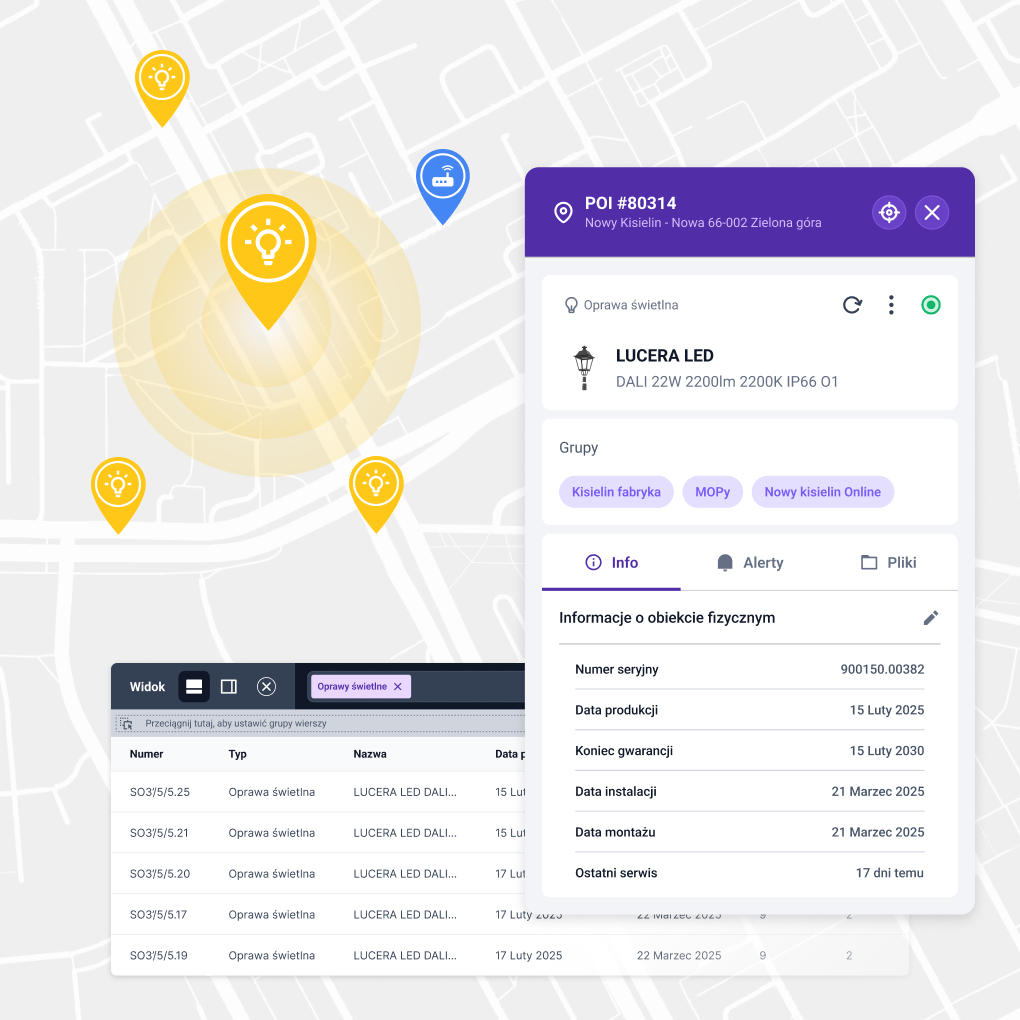
Our inventory module is much more than a table. It is a flexible Asset Manager that adapts to your needs and allows you to gather all data required for asset management in one place.

Interface fragment presenting a digital twin

Inventory anything you need

Do not limit yourself to predefined lists. Define your own asset types to track, such as benches, bins, poles, road signs, playgrounds, or green infrastructure.

Define your own parameters

For each asset, create dedicated data fields that matter to you, from last maintenance date and material type to warranty number and funding projects.

Visualize everything on the map

Each asset is precisely placed on an interactive map with its own icon. Filter, search, and bulk-edit hundreds of objects at once.

Integrated LUG catalog: the future of inventory

For native LUG Light Factory luminaires, all information is already available in place.

Scan and done

Instead of entering data manually, simply scan the QR code of a new luminaire using the mobile app.

Automatic data retrieval

Thanks to integration with the LUG catalog, URBAN automatically fetches and fills all key technical luminaire parameters.

Access to documentation

Directly in the system, you can access luminaire files such as datasheets, manuals, and photometric files.

Automate maintenance and service

Combine precise inventory with a powerful ticketing system and optimize field teams' workflows.

Asset-linked tasks

Create service orders assigned to specific objects on the map (e.g., repair a damaged bench or empty a waste bin).

Full history in one place

Each asset has its own history of events and service interventions, making inspections and upgrades easier to plan.

Efficient coordination

Assign tasks to the right people, track completion status, and receive confirmation with photo documentation.

Questions and answers

No, Urban is a Smart City platform that allows you to manage any elements of urban infrastructure. You can connect and monitor, for example, weather stations, bins, fountains, and even track service tasks.
Yes - the Infrastructure Management module digitizes assets (with attributes), pins them to the map, and links them with service history.
The Urban platform works like a digital database of infrastructure. You can add any objects (e.g., poles, barriers, benches), assign attributes (such as color, installation date, material), and track their status and service history (e.g., by scanning a QR code).
It is a tool for digitizing the work of service teams. When the system detects a fault (or a resident reports a problem), you can create a task (ticket), assign it to a team, track its status, and report completion in the mobile app. The module can be used for any tasks (e.g., "bench replacement").
Urban provides full monitoring and remote control of electrical cabinets. You can remotely control circuits, check switchgear mode, monitor fuses, or inspect network parameters. Contact us, we will review your project and help select the right equipment.
Yes. One function is monitoring cabinet door opening. In case of unauthorized access, the system immediately sends an alert (email or SMS).
Yes. The system continuously monitors power consumption and other electrical parameters in circuits (especially when using analyzers). It enables detection of anomalies and potential theft and immediately notifies you.
Examples include: bin fill-level sensors, parking sensors, air quality sensors (PM2.5, PM10), weather stations, or water meters.
No. The idea of our system is integration. All data flows into a single management panel. On one map you can see lighting status, bin fill level, and infrastructure failures.